Partner Licensing — By Invitation
License the Supervision Layer Your Clients Need
For agent-development consultancies, system integrators, and AI specialists.
White-label the production-tested methodology your clients need to ship autonomous AI agents that close more deals, don’t lose customers through fabrication, and don’t burn budget reasoning over an empty queue.
Start a licensing conversation →Why a license vs the free GitHub Kit
The open-source Kit shows the methodology. The license is the partnership that ships it.
Real working examples
Non-sanitized reference materials from the production MACONA fleet — actual PR diffs, RCAs, cron configs, wrapper scripts, jobs.json examples. Saves your engineers dozens of hours per engagement vs reading sanitized templates.
White-label rights
Brand the methodology as your firm’s framework in proposals, deliverables, and marketing. Adotob attribution required only in internal source files, not in customer-facing artifacts.
Direct line + updates
60-minute onboarding when you start. Quarterly catch-up calls. Email Q&A with 48-hour business-day response. Every Kit update shipped to you as the methodology evolves.
Pricing tracks
Three structures. Pick one. Hybrid is most common.
Track A — Flat License
For firms with steady agent-engagement book
- ✓ Unlimited engagements
- ✓ $50K/yr prepaid (17% off)
- ✓ All license benefits
Track C — Hybrid
Lower royalty in exchange for retainer
- ✓ $1,500 retainer + 5% royalty
- ✓ Quarterly self-reporting
- ✓ All license benefits
Track B — Revenue Share
For firms validating the model first
- ✓ $500 access retainer
- ✓ 10% royalty on engagement rev
- ✓ Suits pre-revenue practices
12-month initial term. Auto-renewal month-to-month. 60 days termination notice. Partner retains rights to use Kit patterns in already-shipped engagements indefinitely after termination.
Production reference
The methodology runs in production daily.
Adotob Solutions operates this fleet in volunteer capacity for a 501(c)(3) nonprofit shipping food, medicine, hygiene products, donated computers, and clothing to communities and schools in West Africa. The eval framework alone runs 16 declarative configs across the fleet daily, with violations auto-filed to a tracked kanban (~54 items).
Single representative week (W19, May 4-8, 2026)
Five disciplines applied in this fleet
- ✓ Wrapper Pattern — killed natural-language-action fabrication
- ✓ LLM-as-Judge Architecture — four-way decision scope at action boundary
- ✓ Eval Framework — 6-dimension declarative evals + kanban-driven violation ops
- ✓ Closed-Loop Bug Protocol — every fix lands with a monitor
- ✓ Corrections-Panel Retro — same-day self-audit catches overclaims
- ✓ Anti-Fabrication Brief Template — constraints in the prompt, not at QA
Public week-19 retrospective with corrections panel intact at fabswill.com.
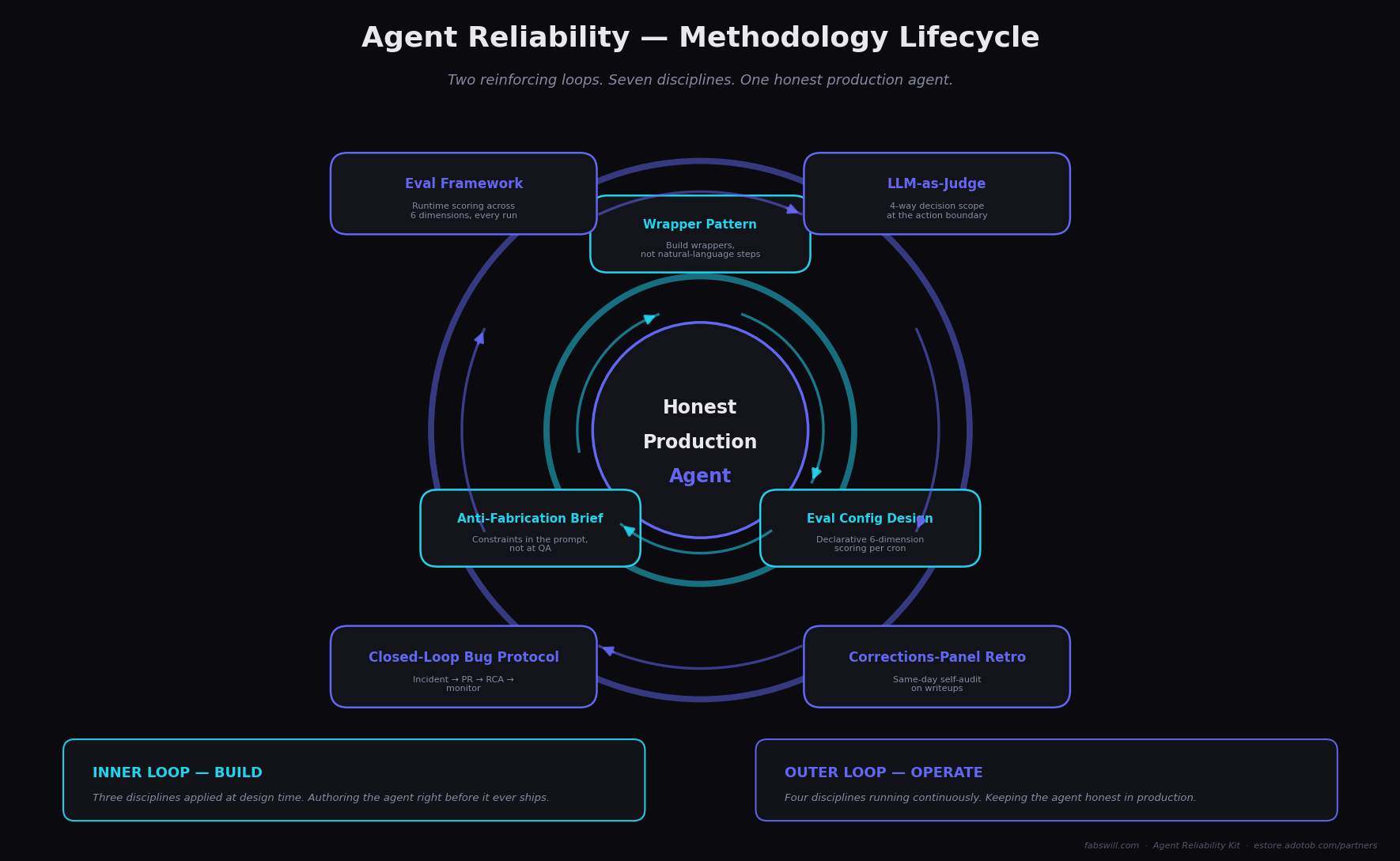
How the disciplines fit together
Two reinforcing loops. Seven disciplines. One honest production agent.
The inner loop is build-phase — three disciplines applied at design time, before the agent ever ships. The outer loop is operate-phase — four disciplines running continuously while the agent serves customers. Together they make the methodology a lifecycle, not a checklist.
Live MCP demo
Try the methodology from your own Claude — right now.
The operator’s reference deployment at mcp.adotob.comis a public MCP server running the full Reliability Kit methodology against a real free-trial bundle purchase. Point your Claude at the endpoint, call the single exposed tool, and walk away with a shareable audit-trail receipt URL that shows all six methodology checks — input validation, rate-limit, daily cost ceiling, lead capture, download-token mint, fulfillment dispatch — for that specific call. The receipt URL is the artifact your client’s security team can forward and verify on their own time.
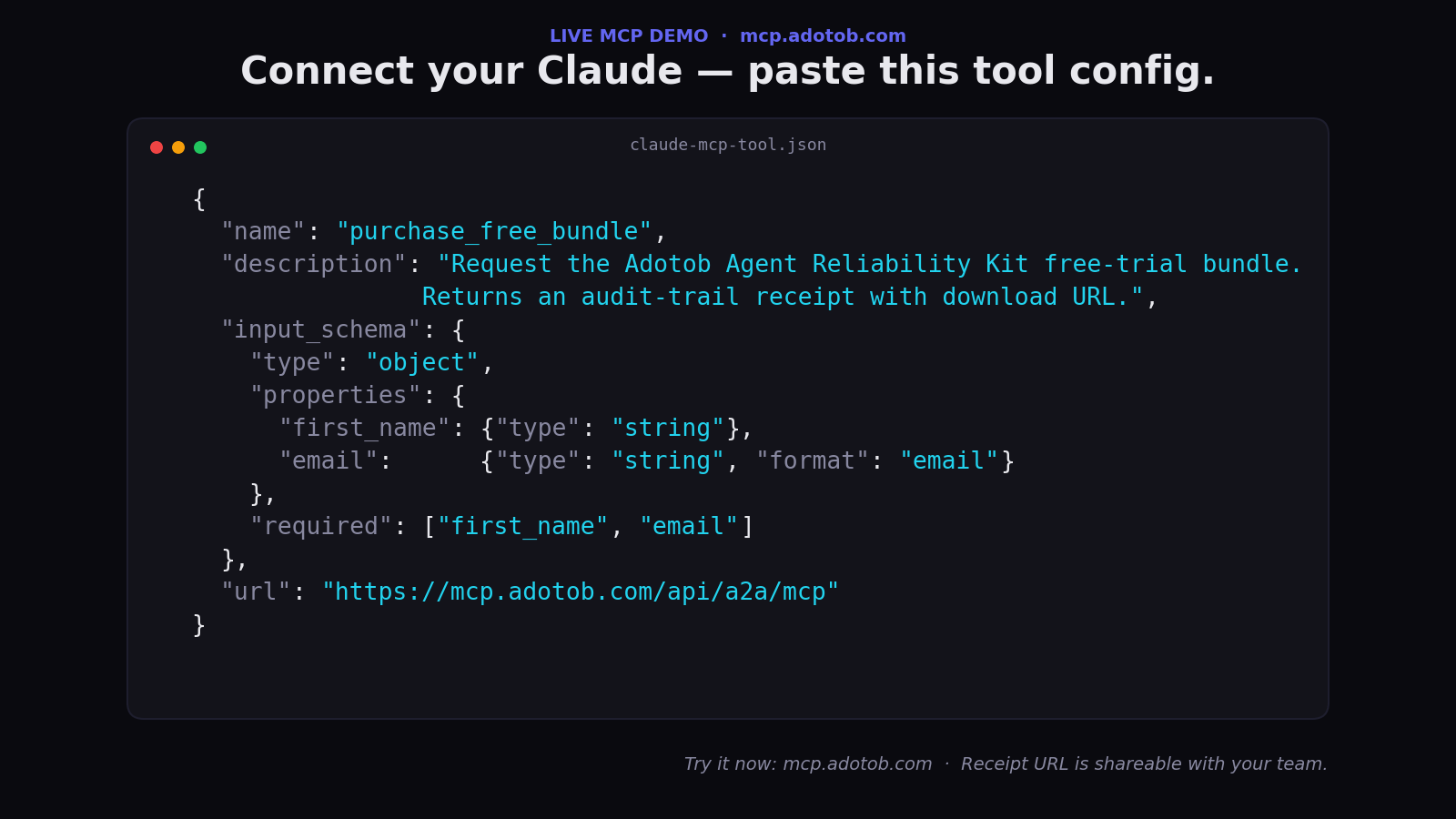
Receipt URLs are publicly shareable. Each demo call is rate-limited per IP. The MCP server runs in a separate Azure tenant with its own cost ceiling.
What you ship to your client
A 7-week productized engagement deliverable.
- Week 1 — Discovery. Map the client’s business objects (lead, opportunity, account, case, policy, customer, vendor, etc.) and identify their high-blast-radius action surfaces.
- Weeks 2-3 — Foundation. Install the Wrapper Pattern across the client’s cron/scheduled actions. Bake the Anti-Fabrication Brief Template into the client’s writer agent prompts.
- Weeks 4-6 — Supervision Layer. Stand up the LLM-as-Judge architecture at the action boundary. Implement four-bucket risk classification and four-way decision scope.
- Weeks 5-7 — Eval Framework. Author six-dimension declarative eval configs per cron job. Stand up the kanban for auto-filed violations. Wire daily-eval-run, weekly review, monthly trend crons. The defensible answer when procurement asks “show me your evals.”
- Week 7+ — Closed Loop. Wire the Closed-Loop Bug Protocol with monitors for the failure classes the client most fears.
- Ongoing — Operational discipline. Train the client’s ops team on the Corrections-Panel Retrospective Pattern.
FAQ
The honest questions partners ask first.
Why pay for something on GitHub?
The public Kit is the methodology in template form. The license adds real working examples, white-label rights, guided onboarding, and ongoing access. Most firms recover the retainer in saved engineering time on the first or second engagement.
Why not just hire an engineer to build this internally?
You can. Estimated cost: $120K of engineer-time and 3-6 months of trial-and-error. The license is right when engineering bandwidth is a constraint and client engagement velocity is the bottleneck.
Can multiple consultants in my firm use it?
Yes. License is per-firm, not per-seat. Reasonable internal use across engineers, solutions architects, and pre-sales is included.
What is the worst-case scenario if I license and it does not pan out?
Up to one quarter of retainer (Track C: $4,500; Track B: $1,500) before deciding it is not fit. 60-day termination notice means at most one additional payment cycle. The Kit patterns you adopted into engagements stay in production at your clients (your derivative IP). Worst case is approximately a quarter of retainer for the option value of trying.
Where is the proof this works in production?
Three places: (1) the case study above with verified MACONA fleet metrics, (2) the public Week-19 retrospective with corrections panel intact on fabswill.com, (3) the Apache-2.0 GitHub Kit you can read in full before signing anything. We are not selling vapor.
Full FAQ (12 questions) and the detailed Licensing Offer available on request.
Start the conversation.
Email fabian@adotob.com with the subject line “Licensing inquiry — [Your firm].” Reply within 48 business hours. First three license-signing partners receive an extra 60-minute architecture review call.
Email fabian@adotob.com →This page is by invitation. It is not linked from the public store nav, and search engines are blocked from indexing it. Share with intent.